

Introduction
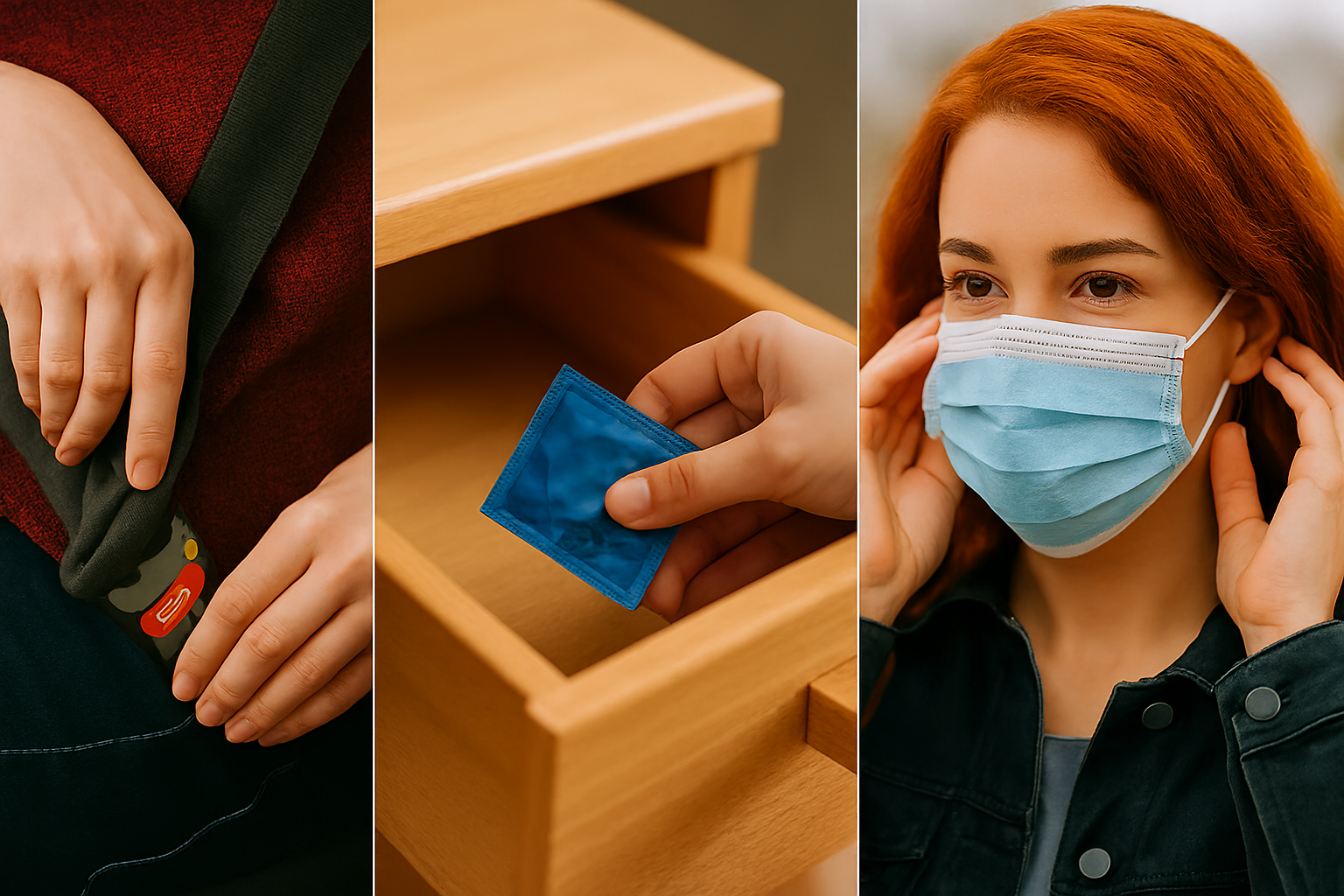
We live in a world where risk is often invisible — embedded in the air we breathe, the roads we travel, and the intimacy we share. Viruses, accidents, and infections do not announce themselves; they arrive uninvited, sometimes with lasting consequences. Yet we are not powerless. Tools like seatbelts, condoms, and masks offer more than protection — they offer personal agency. Each one is a simple intervention, but choosing to use them reflects something deeper: a willingness to accept reality, to act with foresight, and to care for oneself and others. This post explores how these three tools, often met with resistance, have come to symbolize maturity in the face of risk.
Seatbelts: Everyday Foresight
The Need and Role of Seatbelts
The seatbelt is perhaps the most familiar symbol of personal safety in modern life. Its purpose is straightforward: to protect the body against sudden impact, to reduce injury, and to save lives in the event of an accident. Yet its significance extends beyond mechanics. Fastening a seatbelt is a ritual of foresight — a quiet acknowledgment that risk exists on every journey, no matter how routine.
Seatbelts are designed to protect against unpredictability. Roads are shared spaces, and accidents often arise from factors outside our control. A simple strap across the chest and waist distributes force, preventing the body from becoming a projectile in a collision. Over time, fastening a seatbelt has become second nature, a small act that precedes motion and signals readiness for the journey ahead. Importantly, seatbelt design itself has evolved — from simple lap belts to three‑point harnesses and adjustable systems — adapting to public convenience while never compromising on safety.
Cultural Resistance and Normalization
When seatbelt laws were first introduced, many drivers resisted. They claimed discomfort, inconvenience, or even infringement on personal freedom. Campaigns and legislation gradually shifted perception, and the undeniable evidence of lives saved made resistance harder to justify. Still, some defiance lingers even today, though the cultural tide has largely turned toward acceptance.
Maturity in the Ritual of Safety
To wear a seatbelt is to acknowledge vulnerability. It is an admission that accidents can happen, even to the most skilled driver. Choosing to fasten it is a conscious act of maturity, a decision to accept reality rather than pretend invulnerability. In this way, the seatbelt becomes more than a safety device; it is a symbol of agency, reminding us that safety is not passive but chosen, enacted, and reaffirmed with every journey.
Condoms: Intimate Responsibility
The Need and Role of Condoms
Condoms are among the simplest yet most effective tools for sexual health. They protect against sexually transmitted infections and reduce the risk of unintended pregnancies. But beyond their practical function, they carry a deeper meaning. To use a condom is to recognize that intimacy, while deeply human and often joyful, also carries risk. The act of reaching for one is not just about prevention — it is about care, respect, and responsibility toward oneself and one’s partner. Over time, condom design has also adapted to public convenience — becoming thinner, stronger, and more comfortable, while still maintaining their essential role in safety.
Cultural Resistance and Stigma
From the beginning, condoms have faced cultural resistance. In many societies, they were stigmatized as symbols of promiscuity or moral weakness rather than responsibility. Conversations about them were often awkward, cloaked in embarrassment or silence. Even today, stigma persists in certain communities, and the decision to use a condom can be complicated by cultural narratives that discourage open discussion of sexual health. Yet the evidence of their effectiveness has steadily eroded resistance, and they are now widely recognized as essential tools of protection.
Maturity in Private Stewardship
To choose a condom is to act with foresight in the most intimate of settings. It is a quiet acknowledgment that pleasure and responsibility must coexist, that care for another person includes safeguarding their health. This choice reflects maturity — the willingness to accept reality rather than deny it, to embrace intimacy without ignoring its risks. In this way, the condom becomes more than a barrier; it is a symbol of agency, a reminder that true intimacy is built on trust, respect, and responsibility.
Masks: Public Stewardship
The Need and Role of Masks
Masks are designed to interrupt the transmission of airborne illnesses. They protect both the wearer and those nearby, reducing the invisible pathways through which viruses travel. During the COVID‑19 pandemic, masks became a defining symbol of public health, but their relevance extends beyond that moment. In crowded spaces, hospitals, or during seasonal outbreaks, a mask is a simple barrier that transforms vulnerability into foresight.
Cultural Resistance and Politicization
From the beginning, masks faced resistance. Some rejected them as uncomfortable or unnecessary, while others saw them as symbols of control. In certain societies, mask‑wearing became politicized, dividing communities over what should have been a straightforward act of care. Even now, the sight of a mask can provoke debate — some interpret it as fear or compliance, while others see it as responsibility and respect. This tension reveals how public health advice is never purely technical; it is filtered through culture, identity, and perception.
Addressing Objections: Cloth vs. N95
One common objection is that simple cloth masks offer little protection compared to medical‑grade options like the N95. It is true that cloth masks provide less filtration and fit less tightly. Yet the choice is not between perfect protection and none at all. A cloth mask still reduces transmission — it blocks droplets, lowers viral load, and offers some defense rather than leaving the face uncovered. In public health, “some protection” matters, because it scales across communities. When many people adopt even modest barriers, the cumulative effect is significant. A cloth mask may not be ideal, but it is far better than nothing.1
Maturity in Collective Care
To wear a mask is to accept that one’s actions ripple outward. It is an acknowledgment that the air we share connects us, and that protecting oneself also means protecting others. Choosing to wear a mask reflects maturity — the willingness to act not only for personal safety but for the well‑being of strangers. In this way, the mask becomes more than fabric; it is a symbol of stewardship, a visible act of agency that transforms vulnerability into collective care.
Common Threads
Seatbelts, condoms, and masks are all barriers against unseen risks. Each requires a conscious choice, often in the face of stigma, resistance, or inconvenience. Each has evolved in design to adapt to public convenience while maintaining its essential role in safety. And each reminds us that maturity is not about denying vulnerability, but about accepting it and acting with responsibility.
Conclusion
Seatbelts, condoms, and masks remind us that safety is not passive. They are small acts of agency that transform risk into care. True maturity lies in choosing prevention, in quiet rituals that protect life and dignity. Whether on the road, in intimacy, or in public spaces, these tools symbolize the same truth: that acknowledging risk and acting with foresight is the most human form of stewardship.
Footnotes
- See CDC’s Science Brief: Community Use of Cloth Masks (view on CDC Stacks) (2021, pdf available for download), which explains that multi‑layer cloth masks block respiratory droplets and reduce exposure; UKRI’s research on droplet spread (2020), showing masks significantly reduce virus‑laden droplets from speech and coughing; and the meta‑analysis in the Journal of Public Health confirming cloth masks provide measurable though lesser protection compared to surgical or N95 masks.